Experience
11 Minute
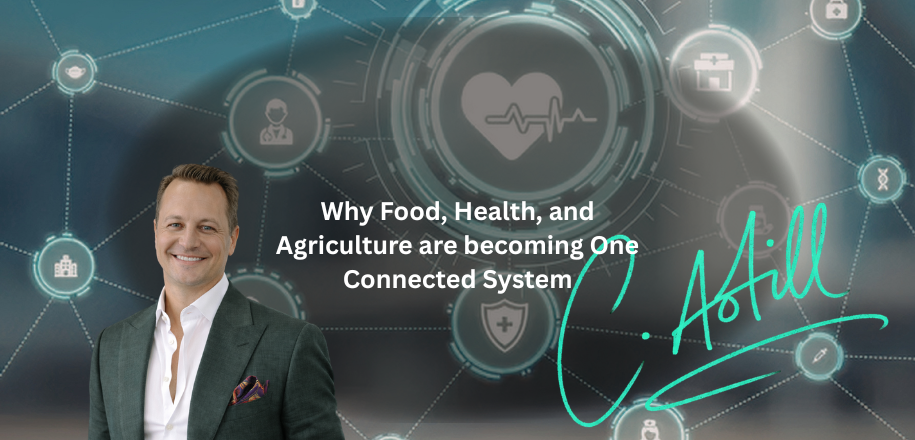
Modern societies often treat food, agriculture, and healthcare as separate industries.
Farming produces food.
Healthcare treats illness.
Supply chains move products.
But these systems are becoming increasingly interconnected.
Food quality influences long-term health outcomes.
Agriculture influences food quality.
Supply chains influence accessibility and cost.
Craig Astill frames this shift clearly:
“The future of healthcare may begin long before hospitals. It may begin inside food systems.”
This changes how governments, businesses, and infrastructure providers may need to think about public health entirely.
Most modern healthcare systems are heavily reactive.
Treatment occurs after conditions develop.
Obesity.
Metabolic disease.
Inflammatory conditions.
Nutritional deficiencies.
These issues create growing pressure across public healthcare infrastructure globally.
At the same time, food systems have changed dramatically over recent decades.
Ultra-processed food expansion.
Industrial supply chains.
Lower-cost, lower-nutrient consumption patterns.
This creates a systems-level feedback loop where agricultural systems influence long-term public health outcomes.
The issue is no longer isolated to medicine.
It becomes structural.
Historically, agriculture was viewed primarily through production and export capability.
That perspective is expanding.
Food systems increasingly influence:
Healthcare expenditure
Workforce productivity
National resilience
Population wellbeing
This creates growing opportunity for systems that connect:
Agriculture
Nutrition
Supply chain intelligence
Public health infrastructure
The future may increasingly reward food systems that optimise not only volume…
But long-term health outcomes.
Technology is beginning to change how food systems operate.
AI-driven agriculture.
Supply chain visibility.
Predictive farming systems.
Food traceability infrastructure.
These systems create greater visibility across:
Nutrient quality
Origin tracking
Environmental exposure
Supply chain efficiency
This allows future food systems to become more intelligent and responsive.
The implications extend beyond farming.
They influence public infrastructure planning itself.
As healthcare costs rise, governments may increasingly focus upstream.
Not simply on treatment.
But on prevention.
This changes how agriculture and food systems are viewed strategically.
Food quality becomes economically relevant.
Nutritional stability becomes infrastructure relevant.
Craig Astill summarises this directly:
“The future cost of healthcare may depend heavily on the quality of systems that exist before illness begins.”
This creates convergence between:
Agriculture
Technology
Public health
Infrastructure planning
The next generation of successful systems may combine:
Agricultural intelligence
Supply chain optimisation
Nutrition systems
Public health analytics
Rather than operating independently.
For example:
Better food distribution systems reduce waste.
Higher-quality food systems improve population health.
Regional agriculture strengthens economic resilience.
This creates overlapping benefits across both private and public sectors.
Regional Australia possesses several long-term advantages:
Agricultural land
Solar exposure
Resource access
Lower-density development potential
As food systems, health systems, and infrastructure become more interconnected, regional capability may become increasingly valuable.
Not just for production.
But for integrated system development.
The future of public health may not be built solely inside hospitals.
It may increasingly begin inside agriculture, logistics, and food infrastructure systems.
Craig Astill frames this clearly:
“The strongest societies will be those capable of designing systems where food, health, and infrastructure reinforce each other rather than operate independently.”
Because modern systems are becoming too interconnected for isolated thinking.
And food may become one of the most strategic infrastructure layers of all.
Read More For More Information