Experience
13 Minute
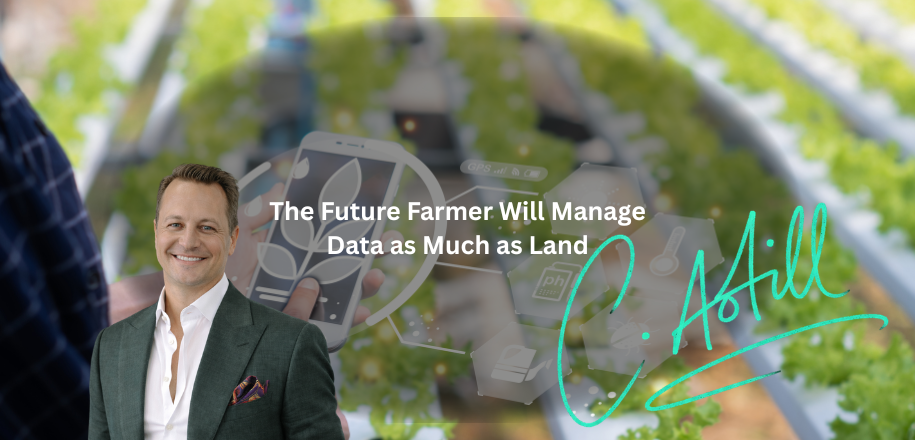
For generations, farming has been built around physical capability.
Managing land.
Operating machinery.
Understanding seasons and weather patterns.
The role of the farmer was closely tied to manual processes and observational experience. Success depended on the ability to interpret conditions in the field and respond accordingly.
That role is evolving.
The future farmer will not only manage land.
They will manage data.
Technology is transforming agriculture from a purely operational industry into an information-driven system. Sensors, automation, artificial intelligence, and connected infrastructure are changing how decisions are made and how farms operate day to day.
Craig Astill frames this shift clearly:
“The modern farm is becoming an intelligence system as much as a production system.”
This changes the skillset required to operate successfully.
Traditional farming relied heavily on manual execution.
Modern farming increasingly relies on system coordination.
Today, farms can continuously monitor:
Soil moisture and nutrient conditions
Weather variability and environmental risk
Livestock movement and health metrics
Machinery performance and operational efficiency
This creates a constant flow of information.
The role of the farmer shifts from periodic observation…
To continuous interpretation.
Technology does not remove decision-making.
It changes the level at which decisions are made.
Historically, agricultural value was tied primarily to land, water access, and production scale.
Now, another layer is emerging.
Information.
Data collected across farming operations allows systems to become more precise, predictive, and adaptive over time.
Artificial intelligence can forecast crop performance.
Automation systems can optimise resource allocation.
Predictive analytics can identify operational risks before they become visible.
The result is a different operating environment.
One where advantage comes not only from what is produced…
But from how effectively information is used.
As agriculture becomes more connected, the skill profile of the modern farmer expands.
Future farming operations increasingly require:
Data interpretation
Technology management
Systems thinking
Operational analysis
This does not replace traditional farming knowledge.
Experience remains critical.
But experience is now supported by real-time visibility and predictive systems.
The modern farmer becomes both operator and analyst.
The integration of technology changes the speed and accuracy of decisions.
Instead of responding after conditions change, farms can increasingly adapt in real time.
Water use can be adjusted dynamically.
Nutrient application can be targeted precisely.
Supply chain conditions can influence operational planning immediately.
This creates a shift:
From reactive farming…
To predictive farming.
Over time, this compounds into significant operational advantages.
As technology adoption increases, a divide begins to emerge.
Operations using integrated systems gain:
Greater efficiency
More predictable outcomes
Reduced waste
Faster adaptation to changing conditions
Those operating without these systems may struggle to remain competitive as environmental pressure, input costs, and market volatility increase.
The gap is no longer simply about scale.
It is about capability.
Craig Astill summarises this transition clearly:
“The future advantage in agriculture will come from understanding systems faster than others can adapt to them.”
The transformation of farming reflects a larger economic pattern.
Across industries, technology is shifting value away from purely manual execution and toward system intelligence.
Agriculture is now part of that transition.
Farms are becoming:
Connected operational environments
Data-driven infrastructure systems
Integrated supply chain nodes
This changes how agriculture is positioned within the broader economy.
The future farmer will still understand land, weather, and production.
But they will also understand systems, data, and operational intelligence.
Because modern agriculture is no longer defined solely by physical inputs.
It is increasingly defined by information.
Craig Astill frames this simply:
“The next generation of farming will not replace traditional knowledge. It will amplify it through systems.”
And in that environment, the advantage will belong to those who can manage both land and intelligence together